
Understanding IDIQ Contracts
What an indefinite delivery, indefinite quantity contract is, how task orders work, and how IDIQ vehicles fit acquisition strategy.
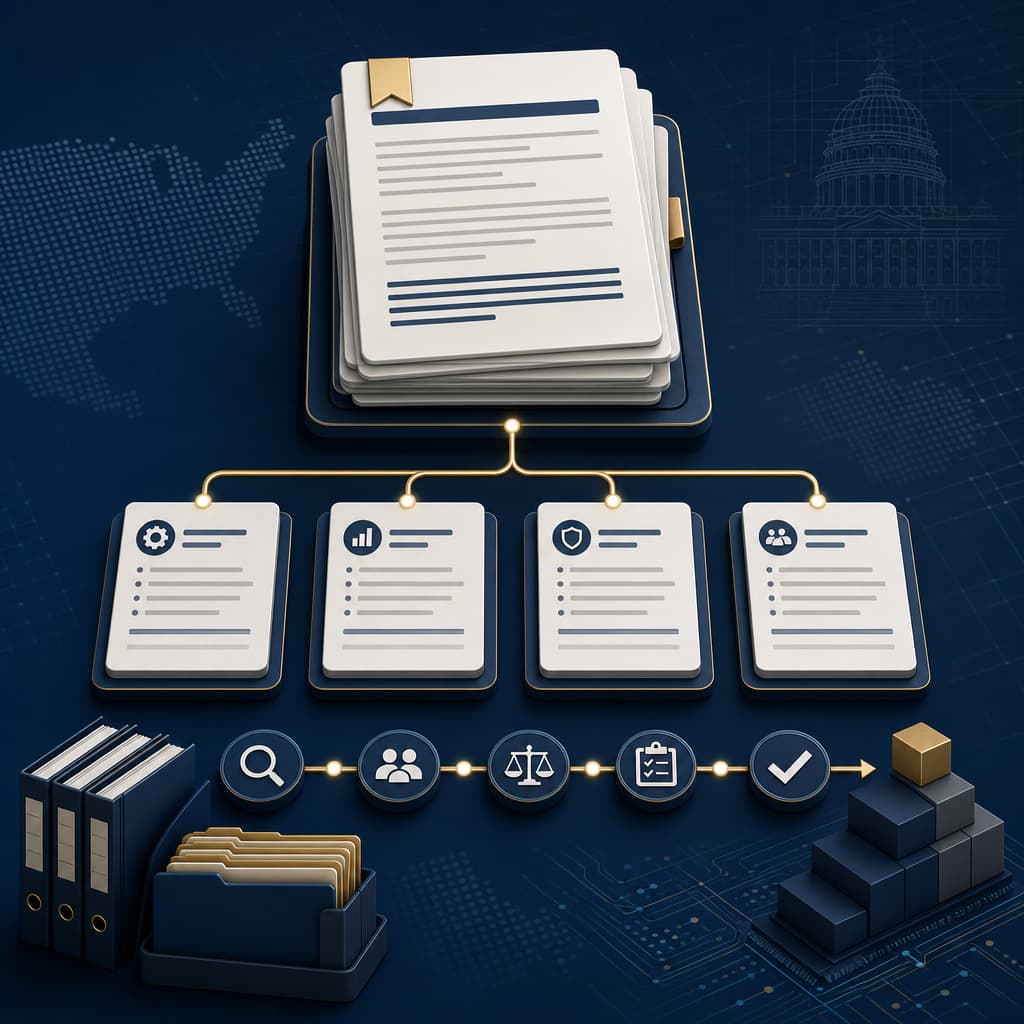
Quick answer
An IDIQ is useful when an agency needs a pre-established contract path for future task orders where exact quantities or timing are not fully known. It reduces procurement friction when the scope family is predictable but the work will be ordered over time.
If you spend any time around federal acquisition, you'll hear "IDIQ" before lunch. The acronym itself - Indefinite Delivery, Indefinite Quantity - does a lot of the explaining: it names a contract that doesn't promise a specific quantity at a specific time. What it does promise is a relationship: a pre-competed vehicle through which agencies can issue task orders quickly, without running a fresh full-and-open competition for every requirement.
This piece is a plain-language primer for program managers, contracting officers, and prime/sub partners who need a working vocabulary.
What an IDIQ actually is
An IDIQ is a base contract awarded to one or more contractors. The base contract establishes:
- The scope of what can be ordered (labor categories, products, mission domains)
- The pricing structure (rate cards, ceiling rates, discount mechanisms)
- The terms and conditions that govern every future order
- A period of performance for the base award - often five to ten years
What it does not establish is what the government will actually buy. That happens through task orders (services) or delivery orders (products), issued one at a time over the life of the base contract.
The two-step ordering process
Once an IDIQ is in place, ordering works in two distinct steps:
- Define the requirement. The agency drafts a task order solicitation - a Statement of Work or Performance Work Statement, an evaluation approach, and a target price.
- Compete the order. The order is competed among the IDIQ contractors who can perform it. This is faster than a full-and-open competition because the base contract has already pre-cleared the contractors' bona fides.
Multiple-award IDIQs (MA-IDIQs) require fair-opportunity consideration among awarded contractors. Single-award IDIQs let an agency direct the order without further competition. Major vehicles such as GSA OASIS+, NIH CIO-SP3, and GSA STARS III are multiple-award.
How IDIQs differ from GSA Schedules
Both are pre-competed acquisition vehicles. The key differences:
- GSA Schedules (the Multiple Award Schedule program) are open continuously to qualified contractors; an agency can buy directly from any Schedule holder's catalog without further competition (above the SAT, with comparison documentation).
- IDIQs have a fixed pool of awarded contractors set at base-contract award. Ordering happens through task-order competitions within that pool.
In practice, agencies often have both options available and choose based on the work - Schedule for catalog-style buys, IDIQ for complex services.
What this means for your acquisition
If you're buying IT services, your acquisition team is almost certainly considering an IDIQ vehicle. The questions worth asking up front:
- Is the contractor a prime on the vehicle? Subcontracting through someone else's IDIQ adds time and dilutes accountability. A prime holds the contract; everyone else passes paperwork.
- Does the contractor's labor categories cover your scope? Each IDIQ has a defined set. If your requirement falls outside, the order can't be issued under that vehicle.
- What's the period of performance left on the base? A vehicle expiring in 18 months is fine for a six-month task order, not fine for a five-year program.
OmniCore is positioned around multiple federal and state acquisition paths, including NMSDC, NASA SEWP V, NIH CIO-SP3, GSA OASIS+, Maryland eMMA, Maryland CATS+, and Virginia VITA. If your acquisition team is considering one of these vehicles or procurement paths, we can walk through how the ordering process would work for your specific scope.
Further reading
- Federal Acquisition Regulation Subpart 16.5 - the source-of-truth FAR section on indefinite-delivery contracts.
- GSA Contracting Resources - overview of the GSA programs most agencies use.
Have questions on a specific solicitation or a vehicle you're considering? Reach our Contracts office and we'll talk through it.
Common questions
- What does IDIQ mean?
- IDIQ stands for indefinite delivery, indefinite quantity. It is a contract structure that lets agencies issue task or delivery orders over time within the contract rules.
- Why do IT buyers use IDIQ contracts?
- IT buyers use IDIQ contracts to speed procurement for recurring or evolving technology needs while keeping ordering inside a defined contract framework.