
Use NIST CSF 2.0 to Scope Cybersecurity Work
Use NIST CSF 2.0 to turn risk, compliance, modernization, and operations needs into a clearer cybersecurity scope.
Quick answer
NIST CSF scoping should start with mission risk, regulatory drivers, current controls, and the operating model. The useful output is not a checklist; it is a practical roadmap tied to the systems, teams, and contracts that must change.
Cybersecurity requirements often arrive as a pile of urgent phrases: compliance, risk reduction, zero trust, incident response, cloud security, continuous monitoring, supply chain, endpoint protection, and governance. Every phrase may be valid, but the acquisition still needs one coherent scope.
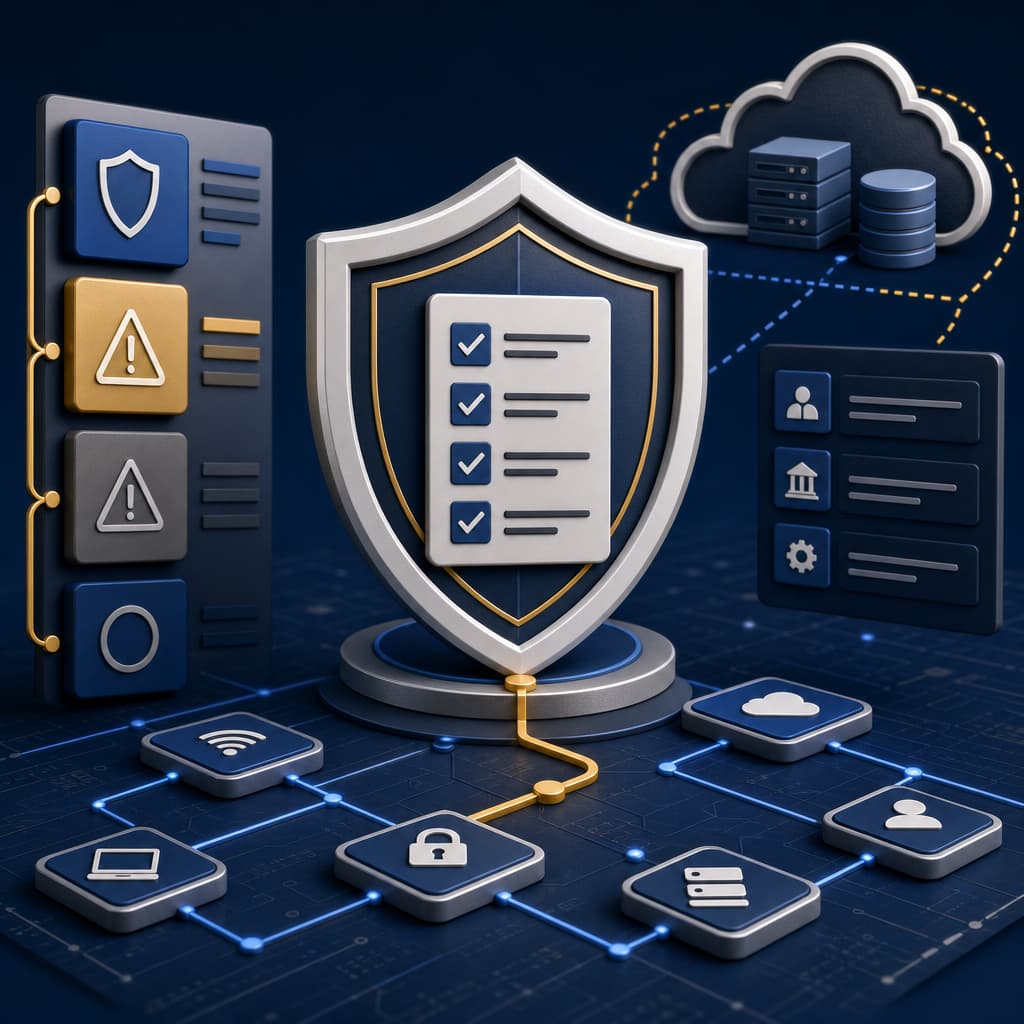
That is where the NIST Cybersecurity Framework is useful. NIST describes the framework as helping organizations better understand and improve management of cybersecurity risk. CSF 2.0 organizes cybersecurity outcomes into six high-level functions: Govern, Identify, Protect, Detect, Respond, and Recover.
For public-sector buyers, the framework should not be treated as a copy-and-paste statement of work. NIST's CSF 2.0 publication is clear that the Core outcomes are not a checklist of actions to perform. The value is that the framework gives program, security, acquisition, and executive stakeholders a shared vocabulary before the team chooses a vehicle, partner model, or technical stack.
That maps directly to OmniCore's cybersecurity and IT governance capability.
Governance changes the shape of the work
The most important CSF 2.0 update for many acquisition teams is the explicit Govern function. Governance pulls cybersecurity out of the tool-buying lane and into the operating model.
When the requirement starts with governance, the team has to answer questions like:
- Who owns cybersecurity risk decisions?
- Which systems, data, users, missions, and third parties are in scope?
- How will policy, control ownership, evidence, and reporting be maintained after delivery?
- What risks are accepted, mitigated, transferred, or escalated?
- Which technical work supports measurable risk outcomes?
Those questions change the acquisition. A tool-only purchase may not solve the problem if nobody owns policy, configuration, monitoring, response, reporting, or sustainment. A consulting-only engagement may not solve the problem if the agency needs engineering, implementation, and operational handoff.
The scope usually needs both sides: governance that defines the risk problem and delivery work that changes the environment.
Use CSF 2.0 to structure discovery
A practical cybersecurity discovery phase can use the CSF functions as a sorting model.
| CSF 2.0 function | Acquisition question | | --- | --- | | Govern | What strategy, policy, roles, oversight, and supply-chain expectations must be established or improved? | | Identify | What assets, systems, data, business context, dependencies, and risks must be understood? | | Protect | What safeguards, access controls, training, architecture, and protective technologies are required? | | Detect | What monitoring, alerting, logging, and detection capability is missing or immature? | | Respond | What incident response planning, communications, analysis, mitigation, and coordination must be ready? | | Recover | What restoration, resilience, lessons learned, and continuity outcomes must be built into the program? |
That table is not a statement of work. It is a way to stop a fuzzy requirement from becoming a fuzzy solicitation.
Once the work is sorted, the acquisition team can decide whether the requirement belongs on a services vehicle, a product-based path such as SEWP V, a state vehicle, or a teaming structure that combines several specialists behind one accountable delivery model.
Tie cybersecurity to modernization
Cybersecurity work rarely stays inside the security office. It affects infrastructure, cloud, applications, data, identity, procurement, and operations.
For example:
- A cloud migration may require identity, logging, encryption, configuration, recovery, and continuous monitoring decisions.
- An application modernization effort may require secure coding, accessibility, DevSecOps, API controls, vulnerability management, and release governance.
- A data and analytics program may require data classification, access control, retention, auditability, and privacy coordination.
- A network modernization effort may require segmentation, remote access design, endpoint security, and operational visibility.
That is why the site separates OSG capabilities but does not isolate them. Cloud and Modernization, Application Development, Data and Analytics, and Infrastructure and Networks all intersect with cybersecurity governance.
Do not over-specify the tool before the outcome
Public-sector cybersecurity teams are under pressure to act quickly, and tooling can be the most visible action. But an acquisition that starts with a product name can miss the harder questions.
Before a tool selection hardens, the team should know:
- Which risks the tool is expected to reduce.
- Which CSF outcomes it supports.
- Who will configure, monitor, operate, and maintain it.
- What data it collects and where that data flows.
- What integrations, authorities, privacy constraints, or agency policies apply.
- How success will be measured after implementation.
Those answers help separate a legitimate product requirement from a broader governance, engineering, or operations requirement.
Where OSG fits
OmniCore helps make cybersecurity scope actionable. That can mean shaping a governance-focused discovery effort, helping map CSF outcomes to a work statement, coordinating cybersecurity with cloud or infrastructure modernization, or building a partner delivery model around specialist work.
The right acquisition route depends on the final shape of the requirement. Some work may belong with professional services. Some may be product-based. Some may need a prime-led partner network. Some may need an initial assessment before a large solicitation makes sense.
The point is to make the requirement defensible before the procurement path is locked.
Official sources
- NIST Cybersecurity Framework
- NIST CSF 2.0 PDF
- NIST Risk Management Framework
- FAR 10.002 - Market Research Procedures
If your cybersecurity requirement is still a mix of risk, compliance, tools, and modernization language, bring OmniCore in before the scope is final.
Common questions
- What should a NIST CSF scope include?
- A practical NIST CSF scope should identify mission context, covered systems, responsible teams, current control maturity, regulatory requirements, and prioritized remediation work.
- Can governance work connect to implementation?
- Yes. Governance work should produce implementation-ready priorities for security architecture, operations, compliance readiness, and modernization teams.